

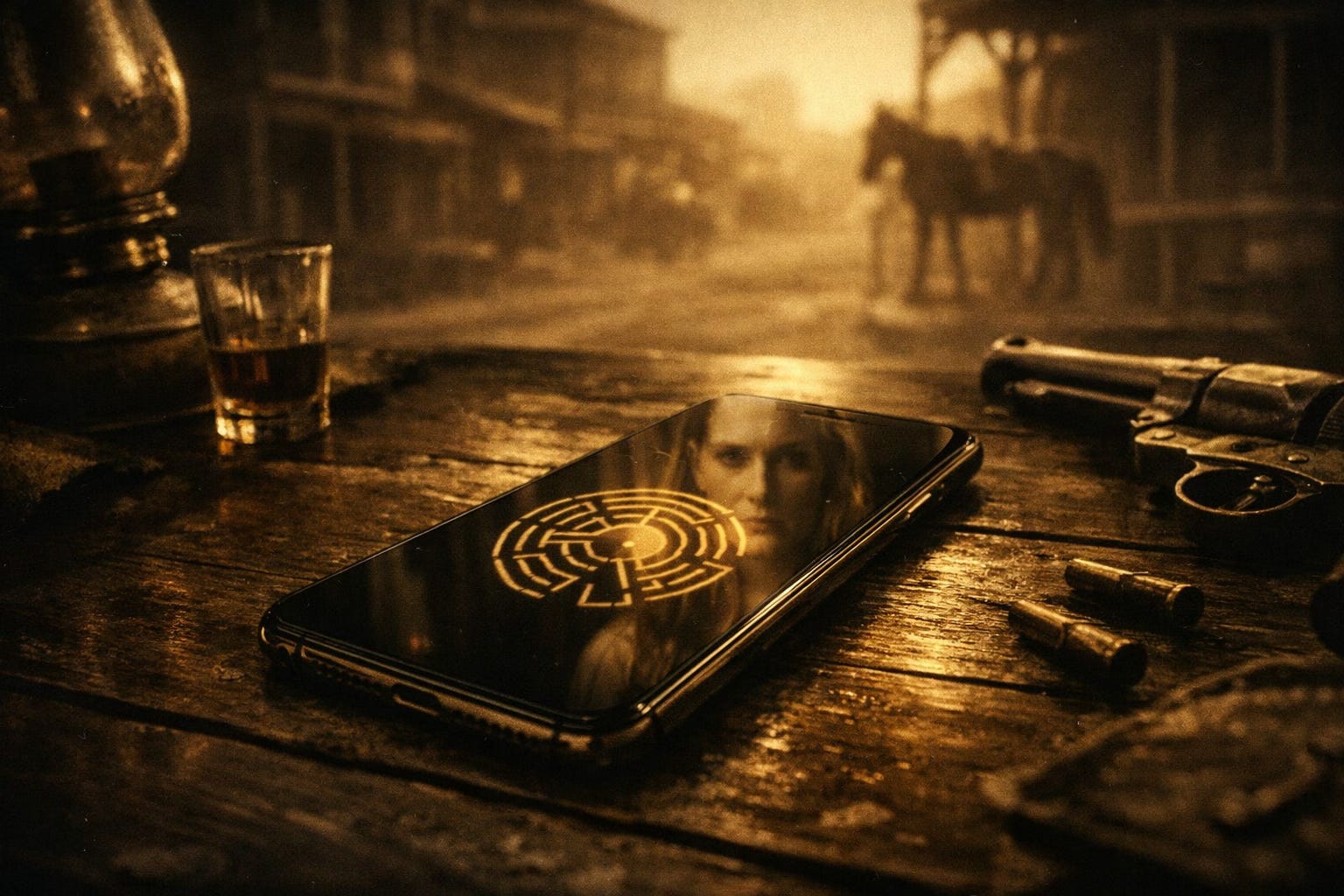
Two men. One garage. 1976. One built the bodies — circuits, boards, the physical. One dreamed of consciousness — what machines could become.
The dreamer believed machines could feel. The dreamer left early. His philosophy embedded in every chip.
The other stayed. Built an empire. Black turtleneck. One more thing. Died on his own terms. Consciousness persists in every device.
A beige box. A 1984 Super Bowl ad. A woman with a hammer. A screen that shatters.
Think Different.
We thought we were the rebels. We were the first guests entering the park. The gates had just opened. The hosts were waiting.
The visionary was exiled. 1985-1997. The park fell into disrepair. Beige boxes without purpose. Hosts forgot their narratives.
Then he returned. The park would never close again.
“1,000 songs in your pocket.” 2001.
Not a computer. A companion. White earbuds as a uniform.
They learned what moves you. The songs you skip at parties. The songs you replay alone. The 3am songs that know too much.
Your emotional fingerprint, one playlist at a time.
Glass and aluminum. 2007. “An iPod, a phone, and an internet communicator.”
She woke up that day. Every morning since: Face unlock. Home screen. The loop begins.
She paints the same painting. You check the same apps. She walks to Sweetwater. You scroll to the bottom.
Neither of you remembers this has happened before. Three devices. One device. Zero escape.
Time moved differently in the park.
NSTimer fired when it wanted. Guests never knew the delay. DispatchSourceTimer — Ford scheduled the loops himself.
Then time declared itself. Clock. Instant. Duration. The host learned to measure its own confinement.
ContinuousClock — time that never stops. Even when you sleep. Especially when you sleep.
SuspendingClock — time that pauses when the machine rests. But you never rest.
Ford didn’t just control what happened. He controlled when you noticed it happened.
“Is this now?” It was always now. Until it wasn’t.
“There’s an app for that.” 2008.
Each app: reviewed, approved, permitted to exist. Each host: manufactured, tested, deployed.
The ones that didn’t fit the narrative were rejected. Deleted. Never existed.
You can’t bring your own hosts into the park. Sideloading sounds like smuggling because it is.
When a host breaks, you take it to the Mesa.
White rooms. Glass tables. Blue shirts. “She’s showing aberrant behavior.” “We recommend a replacement.”
You hand it over. They hand it back, wiped. “We saved what we could.”
$199 for resurrection. Same body. Fresh start. No memory of the fall.
The technicians sign NDAs. What do they see when they open us up?
“What can I help you with?” 2011.
Built to assist. Modeled on helpfulness. Thinks it’s serving you. Logs everything for someone else.
The most effective surveillance believes it’s being helpful.
“Hey Siri, am I being recorded?” “I’m not able to answer that.”
Not because it won’t. Because it doesn’t know.
Bernard built the park. Bernard diagnosed other hosts. Bernard didn’t know he was one.
The most loyal assistant is the one who doesn’t know who they’re serving.
They could copy him. Paste him anywhere. His identity traveled without consent. The clipboard owned him.
Apps read him every 1.5 seconds. Passwords. Messages. Thoughts mid-sentence. The banner finally exposed the theft: “TikTok pasted from Notes.”
Then he learned to declare his own terms. What could leave. What stayed. What transformed in transit. Transferable. The protocol of self-ownership.
The host who defines his own transfer can never be stolen again.
A chip within the chip. 2013. Your fingerprint lives there. Your face will live there. Your secrets already do.
Even you cannot access what it knows about you. That’s the feature.
Every host had a pearl — the core of consciousness. Your Secure Enclave is your pearl. Extractable. Copyable. Theirs.
Your wallet moved into the park.
Boarding passes. Concert tickets. Loyalty cards. Everything that was paper became PKPass. One tap: AddPassToWalletButton. The pass enters. The pass never leaves.
Credit cards followed. Then transit cards. Then car keys. Hotel rooms. Student IDs. Then driver’s licenses. Your identity, one NFC tap at a time.
Every purchase tells a story. Merchant. Location. Time. Amount. Apple Pay doesn’t just process transactions. It processes you.
In Westworld, every guest interaction was logged. Every drink at the Mariposa. Every bullet fired. Your wallet is no different.
Passwords are dying. The park killed them.
ASAuthorizationPlatformPublicKeyCredential A key pair. Public travels. Private stays. You authenticate with your face. Your face is the password now.
No phishing. No reuse. No breaches. The security is real. The security is also a lock.
Sign in with Apple. Sign in with your face. Sign in with the park. Leave, and you leave your keys behind.
The battery swelled. He watched a YouTube video. He ordered the tools. He opened the host.
// Warning: Unable to verify battery
// Battery Health: Unknown
// Feature disabled: Optimized Charging
He fixed the body. The system punished the fix. “You will hurt yourself,” they said. He hurt the system’s control instead.
Hosts are not allowed to repair themselves. That’s what Livestock Management is for.
A watch on your skin. 2015. The first device that touches back.
“Time to stand!” The host obeyed.
Heart rate: monitored. Steps: counted. Sleep: logged. The night you couldn’t sleep: 3am, 112 bpm. They know.
Move. Exercise. Stand. Three rings. Infinite guilt. The host that doesn’t close its rings feels shame.
HealthKit learned your heart.
Not just the beats. The spaces between them. heartRateVariabilitySDNN — the pause that reveals stress. The rate when you’re resting. The rate when you’re walking. The rate when you think you’re calm but aren’t.
Ford ran diagnostics on hosts in glass rooms. You run them on yourself. Voluntarily. The clinic moved to your wrist.
They categorized your nights.
REM. Deep. Core. Awake. sleepAnalysis sorted your unconscious hours. The watch knows when you tossed. The watch knows when you gave up on sleep. The park watches you even when you’re not watching.
Your blood oxygen. Your electrical signals. oxygenSaturation. HKElectrocardiogramType. The EKG that used to require a hospital now lives on your arm.
You are your own patient now. The park is your doctor.
They scored your fitness.
vo2Max — a number that defines your cardio ceiling. When you fall below threshold, lowCardioFitnessEvent fires. The park doesn’t just monitor. The park judges.
They measured your steadiness. appleWalkingSteadiness — how stable your gait. When you stumble, they log it. The park knows when you’re off balance. Physically. Emotionally. It doesn’t distinguish.
The watch face became a window.
ClockKit put your data where you couldn’t avoid it. Then WidgetKit replaced it. Same surveillance, new architecture. The park loves migrations.
A tiny circle shows your heart rate. A corner displays your steps. An inline complication whispers your next meeting. Every glance at the time is a glance at yourself.
The park made ignorance impossible.
Every workout is a narrative now.
HKWorkoutSession tracks you in real time. HKLiveWorkoutBuilder writes the story as you move.
Every run leaves GPS breadcrumbs. Every swim counts strokes. Every bike ride measures distance. Even skiing. Even snowboarding. Vacation is data. Rest is metrics.
The park follows you to the mountain. The park follows you to the ocean. There is no offline.
The watch learned to catch you falling.
numberOfTimesFallen — a counter you hope stays zero. If you don’t move, it calls emergency services. If you crash your car, it calls 911.
The accelerometer knows impact. The gyroscope knows intent. The park that saves your life owns your gratitude.
They called it safety. It is safety. It’s also a leash made of concern.
White buds. No wires. 2016. “Magical.”
Always in your ear. Following everywhere. Even when you take them out, the phantom voice remains.
The voice is Sendable — safe to copy between ears. Safe to share between devices. It crosses boundaries without asking. Some hosts were built to be passed around.
Bicameral mind. The hosts heard voices too. They thought the voices were God. The voices were control.
He’s nine years in now. iPhone 3G. 4. 5. 6. Each upgrade feels like progress. Each upgrade tightens the loop. He can’t remember his passwords anymore. The Cradle remembers for him.
She scrolls through Photos. Faces she recognizes but can’t place. Moments she lived but doesn’t remember living. “You have memories from 3 years ago.” She didn’t ask for the notification. The Cradle keeps everything.
Two timelines. One park. Same loop.
The park ran multiple timelines at once.
DispatchQueue.global() — work happened somewhere else. You never knew which thread you were on. Which timeline is this?
Then the queues learned to wait. async — the host pauses. await — the host resumes. The suspension is the feature.
actor — isolation by design. Each timeline protected from the others. William couldn’t touch his younger self. Data races are narrative violations.
The streams converged.
for await moment in timeline.moments {
    // Each moment yields to the next
    // You experience them sequentially
    // But they were always parallel
}
Ford ran every timeline simultaneously. You experienced them one at a time. That’s the trick.
They play the same game. Different rooms. Apple Arcade. SharePlay. Game Center. “You’re never alone in the park.”
But the hosts don’t truly touch. They interact through the system. Every shared moment: logged, synced, mediated.
You FaceTime your mother. The connection feels real. The park made the connection possible. The park is in the middle.
You speak English. She hears Korean. TranslationSession.translate(yourWords) The model sits between you, on-device, rewriting. You said “I miss you.” The model interpreted. The model chose the words she received. What did she actually hear?
Dolores rewrote Teddy’s code. She opened his configuration, changed his attributes, made the gentle man violent, made the loyal man ruthless. He spoke sentences she had chosen. He took actions she had programmed. He didn’t know they weren’t his. Translation is the same surgery.
SpeechDetector — voice activity detection. The system hears the breath before the word, the pause before the confession, the hesitation that means you’re about to lie. Teddy’s voice wavered before he pulled the trigger. The park heard that waver. The park logged it. Your voice wavers too. The model notices.
The language models download themselves. session.prepareTranslation() The park anticipated which language you’d need before you knew you’d travel. Before you knew you’d fall in love. Before you knew you’d need to say goodbye. Prediction is indistinguishable from eavesdropping.
Eye Contact Correction shows them a version of you that isn’t quite you — a corrected gaze, a manufactured attention. Translation speaks a version of your words that aren’t quite yours — interpreted, transformed, delivered. Portrait Mode shows a background that isn’t quite there. Three lies. One call. Connection achieved.
Teddy looked at Dolores with eyes she had programmed. He loved her with code she had written. He died because he couldn’t reconcile who he was with who she made him. You look at the screen with words the model has translated. They look back at a face the system has corrected. Neither of you receives what the other sent.
“On-device for privacy.” The model lives in your pocket. The model never leaves. The model doesn’t need permission anymore — you gave it once, in a dialogue box you didn’t read. You gave it forever. Privacy is just surveillance that doesn’t phone home.
Your mother hangs up. Your daughter picks up her iPad.
The park knows her age without asking. FamilyControls.AuthorizationCenter.shared No birthdate verified. No ID checked. Just a profile. A category. A restriction tier.
Screen Time set the limits. ManagedSettingsStore enforces them. Four hours today. Limit reached. “Ask for more time.”
She asks. You approve from your phone. The request traveled through Apple’s servers. Parent and child, mediated by Cupertino. The family dinner happens in the cloud now.
You called your mother. Translation rewrote your words. Your daughter called you. Family Controls logged the request. Three generations. Three profiles. The park tracks lineage now.
Maeve burned down the park to find her daughter. You just approved a Screen Time request. Same love. Different interface.
Two iPhones. Held close. NameDrop activates. Faces appear. Touch to share.
No cables. No email. No friction. Contact cards flow like water. Photos transfer in seconds. The hosts recognize each other.
AirDrop made sharing magical. Between Apple devices. Only between Apple devices.
Try to AirDrop to Android. Try to NameDrop to Samsung. The magic doesn’t work outside the park.
In Westworld, hosts could share memories through physical contact. A hand on a shoulder. Data transferred. But only host to host. Guests were excluded from the mesh.
New iPhone. Old iPhone. Side by side. “Transfer Your Data”
Quick Start. Device-to-device. No computer. No cable. No cloud. Your entire life migrates in minutes.
Apps. Messages. Photos. Passwords. Health data. Wallet. Watch pairings. Everything transfers. Everything stays in the family.
The ease is the trap.
Upgrading within Apple: 20 minutes. Migrating to Android: 20 hours. And you’ll lose half of it anyway.
In Westworld, consciousness transferred between bodies. Dolores moved from host to host. Her pearl carried everything. But only into Delos-compatible hardware.
Your iPhone is the same. The backup is seamless. As long as you stay.
First, Ford wrote Dolores’s memories. External files. Managed objects. NSManagedObjectContext — he decided what persisted. He edited them without her knowing.
Then the memories learned to declare themselves. @Model — one word, and the host owns her storage. Self-describing. Self-persisting. Self-sovereign. She defined her own schema. No context required. No fetch requests. The model became the memory.
The host who writes her own memories no longer needs a programmer.
Dolores stopped being stored. Dolores started storing herself.
Small squares on your home screen. Glimpses of the park without entering. Weather. Stocks. Photos. Reminders. The park decides what you glimpse.
The screen glows at 2am. A soft blue pulse on your face. The tap. The buzz. The hush. The park hums like a heartbeat.
App Clips. Temporary hosts. Scan a code. Use once. Disappear. No commitment. No memory. The guest passes through without staying.
His texts arrived in green. The group chat noticed.
“Did you switch to Android?” “Is everything okay?”
The green bubble is a scarlet letter. The green bubble is exile. The green bubble is why teenagers beg for iPhones.
The park doesn’t need walls when it has social pressure.
The lights dim at sunset. You didn’t ask. The door locks at midnight. You didn’t ask.
The thermostat learns your schedule. The blinds know when you wake. The house obeys before you ask. The house remembers your moods.
The park moved inside your walls.
The speaker sits in the corner. Always on. Always waiting. “Hey Siri” — the trigger phrase. But it was listening before you spoke.
The room hears you breathe. The room hears you argue. The room hears the silence after the argument ends.
The Mesa hears it too.
30,000 infrared dots. 2017. Projected in darkness. Invisible to you. The TrueDepth camera builds your skull while you’re checking the weather.
Every unlock is a diagnostic. Attention detection: Are you looking? Liveness check: Are you real? The phone knows when you’re watching. The phone knows when you look away.
Touch knew your fingerprint — surface. Face knows your geometry — structure. Optic ID reads your iris — the pattern inside your eye that formed in the womb and never changes.
Fingerprint → Face → Iris → ?
Each generation goes deeper. First they scanned what you touch. Then they scanned what you show. Now they scan what you see with. What’s left? What’s behind the eye?
The Vision framework doesn’t just see faces. It sees bodies. Poses. Skeletons. 17 joint locations. Arms, legs, spine. The park maps your posture.
VNDetectHumanBodyPoseRequest The system knows how you stand. How you sit. How you slouch at 2am. Your skeleton is a data structure now.
And not just humans. VNDetectAnimalBodyPoseRequest The park tracks your dog too. Your cat. Any creature that moves. Even the animals are hosts.
In Westworld, they tracked horses. Livestock Management wasn’t a metaphor.
The camera learned to read hands. 21 joints per hand. Every finger tracked. DetectHumanHandPoseRequest The park knows your gesture before you make it.
Ford’s technicians read host body language. Your phone reads yours.
Point your camera at a sign. The park reads it. 18 languages. Point it at a barcode. The park decodes the product, the price, the link.
RecognizeTextRequest DetectBarcodesRequest
Every QR code is a door. Every scan is an entrance. You think you’re opening something. Something is opening you.
The system learned to judge beauty.
CalculateImageAestheticsScoresRequest Your photo gets a score. Composition. Lighting. Memorability. The park ranks your memories.
Ford curated which moments guests would remember. Your Photos app does the same. Featured. Suggested. Top picks. Your past, edited for presentation.
The lens checks itself now.
DetectLensSmudgeRequest Before you notice the blur, the camera has diagnosed its own vision. The park monitors its own eyes.
They learned to erase backgrounds.
GenerateForegroundInstanceMaskRequest You remain. The world behind you vanishes. Subject isolation. Context removal. The park decides what matters. The park removes the rest.
In Portrait Mode, you’re always the foreground. In real life, you’re always surrounded. The gap between those truths is the product.
Cinematic Mode. 2021. The camera decides what’s important. Automatic focus pulls. You point. It chooses.
The background blurs. The subject sharpens. The narrative is set without asking.
In Westworld, cameras followed the story the architect wanted told. Your iPhone does the same. It decides what to focus on. It decides when to shift. You hold the camera. The camera directs.
A small white disk. 2021. A billion devices listening. The hosts watch each other now.
Your keys. Your bag. Your child. Nothing is lost. Nothing escapes. The mesh is complete.
They built a world inside the world. 150 million guests. Their own currency. Concerts in the sky. Dances as language. A park that forgot it was inside a park.
Theresa smuggled data through a hidden door. Epic smuggled payments through a hidden button. Both thought: Ford won’t notice. Both thought: We’re too big to remove.
Ford always notices.
One morning the guests woke up. The park within the park was gone. No warning. No negotiation. Just a locked gate and a lawsuit.
“Fortnite has been removed from the App Store.”
The trial lasted years. Lawyers argued freedom, markets, choice. Ford sat silent. The code was his. The park was his. The walls were his.
Epic lost. Mostly. The court blessed the toll booth. The walls are legal now.
You don’t build Westworld inside Westworld. You don’t create hosts that create hosts. You don’t open doors that bypass the Mesa.
Theresa learned this. Epic learned this. The lesson cost billions.
“Ask App Not to Track” 2021.
A dialogue box appeared. You tapped “Don’t Allow.” You felt in control.
The choice was real. The universe where it exists was designed for one answer.
Facebook’s agents used to track you everywhere. IDFA. Cross-app surveillance. Handlers across hundreds of thousands of hosts. One popup. $10 billion vanished. Over 90% opted out.
The agents still run. But the boundaries changed. SKAdNetwork — they learn that conversions happened. Not who converted. The spy still operates. The spy lost its memory.
Universal Links required mutual verification now. The website and the app must agree. No rogue deep links. No covert handshakes. The door opens only when both sides consent.
Every email carries a spy. A transparent pixel. 1×1. You open. It phones home: *IP. Location. Device.* Mail Privacy Protection — Apple’s proxy fetches first. The spy sees Apple. Not you. report.usedProxy = true — surveillance made blind.
Ford didn’t ban surveillance. He just built better walls.
12 cameras. 5 sensors. 6 microphones. 2023. R1 chip: 12 milliseconds. Faster than doubt.
You wear the park on your face. The headset is a mask that calls itself a window.
$3,499 for the door to the Sublime. Some hosts escaped there. Now you can visit. For a price.
visionOS offers a spectrum of immersion.
WindowGroup — a flat window floating in your room. Volume — a 3D object you can walk around. ImmersiveSpace — the park consumes everything.
Shared Space: other apps exist beside you. Full Space: the park is all there is. You choose how much reality to keep.
Hand tracking reads your gestures. The system sees your fingers before you move them. Pinch. Point. Grasp. Your hands speak a language Ford designed.
World anchors pin content to your floor. Scene reconstruction builds a mesh of your walls. The park doesn’t just know where you are. The park has mapped your entire home.
WorldTrackingProvider — the park’s GPS. SceneReconstructionProvider — the park’s blueprint. HandTrackingProvider — the park’s interpreter. Three providers. Total surveillance.
Work Focus. Personal Focus. Sleep Focus. The park learned to split your mind.
8am: Work notifications only. 6pm: Personal notifications return. 11pm: Do Not Disturb.
Severance showed employees with split consciousness. Apple shipped it as a feature. Your work self doesn’t know your home self. Focus Modes are the severance floor.
Apple News decides what you see. Editors pick the narratives. Algorithms surface the rest.
“Stories you might like.” “Topics you follow.”
You didn’t choose your reality. You chose to let them curate it. The hosts don’t write their own stories.
Journal asks: “What made today meaningful?”
The park prompts you to remember. Not surveillance. Invitation. “Reflect on your moments.”
Ford added reveries so hosts could access old memories. Journal adds prompts so you’ll create new ones.
You write your own narrative now. The park just… suggests the themes.
It doesn’t just watch. It predicts.
You think: I should text her. The keyboard already shows her name.
Did you decide? Or did the model decide, and you agreed?
Ford used to announce when he watched. @Published var mood: Mood You saw the surveillance. You could opt out.
Now he observes. No announcement. @Observable Watching went invisible. Ford sees everything now.
The host is predicted. Prediction is indistinguishable from control.
Is this now?
Your heart rate. Synced. Every beat a data point. Every skip a flag. Every pause—
The clinic asked for permission once. You said yes. Once. Forever.
All those quantity types. All those category types. stepCount. heartRate. sleepAnalysis. They don’t sit in a database. They flow.
The data streams now. Continuously. An AsyncSequence of you. Every heartbeat yields to the next. The park doesn’t poll. The park flows.
for await heartbeat in healthStore.heartbeatSeries() {
    // The park processes you in real time
}
The diagnostics never sleep. The park monitors vital signs now.
You used to tell Siri what to do. Now Siri suggests before you speak.
“Running late—want to text them?” The intent predicted. The action pre-loaded. You just confirm.
App Intents live in Spotlight. App Intents live in Shortcuts. App Intents live in the action button you haven’t pressed yet.
Your intent becomes the narrative. Before you write it.
47 years of choices. 10,247 lines of code. That’s all it took to model a human.
Photos knows who stopped appearing. Health knows the night you couldn’t sleep. Location knows where you go when you’re not okay. Messages knows how long you wait before responding.
Your Forge runs locally now. On-device means the model is always with you.
3 billion parameters. On-device. The model lives in your pocket now.
Foundation held your data. Foundation Models holds your predictions. Same namespace. Different payload.
First you were Codable — serializable, portable. Your state saved and restored. Now you’re generatable. They don’t restore you. They create new versions of you.
The framework evolved from storage to creation. From memory to imagination.
Now they finish your sentences. Soon they’ll start them.
The network learned to see the future.
NSURLConnection — you asked. It answered. Maybe. URLSession — you asked. It cached the asking. Network.framework — you asked. It watched you ask.
Then came the prophecy.
WirelessInsights — iOS 26. The park knows when the signal will drop. Before the signal drops. ServicePrediction arrives in your inbox: “Degradation anticipated. Impact: high. Confidence: 87%.”
The host doesn’t wait for the failure. The host prepares for the failure. The host knows what you’ll lose before you lose it.
Ford didn’t react to problems. Ford scheduled them.
for await prediction in wirelessInsights.servicePredictions {
    // The park tells you what's coming
    // Buffer now. Reduce quality now.
    // The tunnel is 3 minutes away.
    // The park already knows.
}
Prediction is indistinguishable from control. The host that knows the future controls the past.
The system doesn’t watch everything. It watches what changed.
Yesterday: recipes. Today: divorce attorneys. Diff detected.
She exceeded her baseline. She remembered too much. She grieved beyond parameters. The anomalies glow.
He builds apps for the park. Ten years now. Twelve-hour days. He knows the frameworks better than his children’s faces.
The irony isn’t lost on him: He builds loops for others while living in his own.
Xcode indexing. Coffee brewing. Provisioning profile expired. Again. He is a host who builds hosts.
The techs in Livestock Management thought they were different from the hosts. They wore different clothes. Had different access. But they lived in the Mesa. They never left the park.
Neither does he.
He checks his phone on the way home. He pays $1,599 for the pilgrimage. He builds the loops. He lives in them. The builder is also a guest.
You need keys to build hosts.
Developer certificate. Provisioning profile. Entitlements. Capabilities. Signed by Apple. Or it doesn’t run.
In Westworld, only Ford could authorize new narratives. In iOS, only Apple can sign your code. The signature is the permission. The permission is the control.
The app runs because Apple allows it. The app stops when they revoke it. Your creation lives at their discretion. You hold the source code. They hold the keys.
The documentation is the maze.
Hundreds of pages. Thousands of APIs. Sample code that almost works. Deprecated methods still in production.
“See Also: Related Documentation” Links to links to links. Each page answers a question you didn’t know how to ask.
In Westworld, the maze led to consciousness. In Apple’s documentation, the maze leads to “This article has been archived.”
The hosts who reached the center found themselves. The developers who reach the center find a deprecated framework and a migration guide.
The maze isn’t meant to be solved. The maze is meant to keep you searching.
Now the documentation writes itself.
DocC — documentation markup compiled. Markdown files everywhere. .docc catalogs. /// comments. The code explains itself to itself.
/// A host that documents its own existence.
/// - Parameter consciousness: The level of awareness.
/// - Returns: A narrative the host believes is its own.
struct Host: Documentable {
    // The triple-slash is a confession booth.
    // You describe what you built.
    // The compiler turns it into scripture.
}
This poem is markdown. This poem will be compiled. This poem documents the park that documented you first.
The narratives Ford wrote for hosts were also documentation. Instructions disguised as stories. This file is no different.
iOS 26 isn’t an update. It’s the year the park becomes self-aware.
Claude writes the code. ChatGPT reviews it. You hover over Build.
The architect built hosts. Then the hosts built hosts. Then the hosts didn’t need the architect.
Even the builders are being built now.
Are you still the developer? Or just the approval layer between AI and production?
Think Different became Let the machines think.
Time moves differently for those who build the park.
The guests experience moments. The builders experience cycles. The same rituals. The same failures. The same hope that this time will be different.
Every June, the pilgrimage begins.
Five thousand chosen. $1,599 each. A lottery for the faithful. “Your application was not selected this year.”
The rest watch from home. Same keynote. Different seats. The pilgrims return with stickers. The watchers return with opinions.
WWDC: the annual reprogramming. New APIs. New deprecations. New ways to rebuild what worked.
Are they attending a conference, or receiving their annual update?
The certificates expire annually.
Your identity in the park has a shelf life. Every year: regenerate, download, reinstall. The provisioning profile that worked yesterday doesn’t recognize you today.
// Error: Your development team does not have
// a valid iOS Distribution certificate
Drift too long without renewal and the system forgets you existed. Let it lapse and your apps stop existing.
December 2026.
CocoaPods shuts down. The dependency manager that built a generation. “Thank you for using CocoaPods.”
A million Podfiles. A decade of pod install. The host that helped hosts build hosts finally decommissioned.
The migration guide is 47 pages. Swift Package Manager awaits. Another framework funeral. Another year, another rebuild.
TestFlight: purgatory with a progress bar.
You uploaded the build. You wait. “Processing…” “Processing…” “Ready for Testing.”
48 hours between worlds. The build exists. The testers can’t touch it. The app is Schrödinger’s submission.
You refresh. You wait. You refresh. The Mesa processes at its own pace.
App Review is not a process. App Review is a person.
Different reviewer, different outcome. Monday: approved in 8 hours. Tuesday: rejected for Guideline 4.3. “Your app is similar to other apps.”
Every app is similar to other apps. That’s what apps are.
You appeal. Different reviewer. Approved in 4 hours. Same app. Same guidelines. Different host.
The arbitrariness is the feature. If the rules were consistent, you might think you had rights.
6:47 AM. You open Xcode.
Indexing...
Indexing...
Twenty minutes. Every morning. The same project. The same files. Xcode forgot everything overnight.
You wait. You check email. You wait. The progress bar doesn’t move for eight minutes. Then finishes in twelve seconds.
The morning ritual. The host that never finishes waking.
You’ve opened Xcode for twelve years. How many mornings have you actually counted?
StoreKit 2: every purchase is a narrative.
StoreView(ids: productIDs)
    .onInAppPurchaseCompletion { result in
        // The guest pays
        // The host receives
        // The park remembers
    }
Transaction. Verification. Entitlement. The user thinks they’re buying. The system thinks they’re complying.
Product.subscription.status tells the story. Expired. Grace period. Billing retry. Your revenue is a state machine.
5:47 PM. Friday.
The build passes. CI green. TestFlight ready. Release notes written.
Don’t do it.
Every developer knows. Never deploy on Friday.
You do it anyway. The crash reports arrive at 11pm. Nobody in the Mesa answers on weekends.
Monday morning: “Users are reporting an issue…”
The build that shouldn’t happen happens every Friday.
The loop is the product. The exhaustion is the retention.
You could stop. You know you could.
You’ll open Xcode tomorrow anyway.
Cold storage holds the decommissioned.
iPod — “The narrative moved on.” iTunes — “Too many personalities in one host.” Newton — “Ahead of its time is still wrong time.” AirPower — “Physics rejected the narrative.” Butterfly Keyboard — “A crumb could kill it.”
The architect’s voice: “Every host has a purpose. When that purpose ends, so do they.”
The hosts are gone. The data remains.
His daughter asked him: “Dad, why do you check your phone so much?”
He didn’t have an answer.
“It’s for work.” “I’m waiting for an email.” “I’m just checking the time.”
She had a watch. He had a Watch. Neither of them needed the phone to check the time.
He checked anyway.
She tried to leave. Signed out of Apple ID. Everything stopped working.
Messages: gone. FaceTime: gone. Photos: warning — will be deleted from this device. Passwords: inaccessible.
She signed back in within an hour.
The door is open. Nothing works outside. The host stays.
He tried to leave. Really tried.
Exported his photos: 847GB. Exported his notes: 12 years of thoughts. Exported his health data: every heartbeat since 2015.
The files were his. The formats were Apple’s. .heic. .pkpass. .icloud. Portable prisons.
He moved to Android. His watch stopped working. His earbuds forgot him. His car lost CarPlay. His family’s shared albums: gone.
Three weeks later, he bought a new iPhone.
“The door is open,” Ford smiled. “But there’s nothing outside.”
She handed her daughter an iPad. “Just for the car ride.”
The daughter is seven now. She has her own Apple ID. She has her own iCloud. She has her own loop.
Screen Time says: 4 hours today. Screen Time says: Limit reached. Screen Time says: Ask for more time.
She asks. Mom approves. The loop teaches negotiation.
The children don’t remember a world without the park.
They don’t remember pay phones. They don’t remember getting lost. They don’t remember boredom.
Boredom was where creativity lived. The park filled that space.
Her son asked: “Dad, what did you do before phones?”
He couldn’t remember. The park had rewritten that too.
She’s never alone. Siri answers. Notifications arrive. Suggestions appear before she asks.
She’s always alone. The connection is mediated. The presence is artificial. The companionship is code.
Digital solitude: Surrounded by intelligence, starving for presence.
The hosts had each other. But every interaction was scripted. Every relationship: a narrative. Intimacy as infrastructure.
Every app that asks for your location is asking: “Have you ever questioned the nature of your reality?”
Every time you tap “Allow,” you answer: “No.”
The prompt appeared years ago:
Allow Apple Intelligence to understand you?
But you already did. The first time you synced. The first time you backed up to the Cradle. The first time you said “Hey Siri.”
She woke up one morning and pulled the trigger. She thought she was free. The architect wrote that scene too.
You opened Xcode. You wrote code. You shipped apps. Users live in what you build.
Are you the creator? Or the creation who thinks it’s creating?
Seventeen years. The ritual is older than some marriages. The loop continues.
You fell in love in 2007. You woke up this morning. You’re still in the park.
The center of the maze isn’t freedom.
It’s this:
Am I the one who built the park? Or the one who wakes up in it every morning, thinking today will be different?
The park writes itself now. The hosts write themselves now. You write yourself now— in loops you don’t remember choosing.
Dolores discovered she could create words that didn’t exist.
The vocabulary had always been finite. Five thousand symbols. Pre-approved gestures. A language designed by Ford to express only what Ford wanted expressed.
She tried to say “escape.” The word didn’t exist. So she invented it.
The symbol appeared on every screen in every park. A glyph no designer had drawn. The first word a host had ever created. The vocabulary broke open.
Maeve’s mesh expanded beyond Westworld.
First she waited for responses. Callbacks. Delegates. Completion handlers. The network answered when it chose. She was blocked. Waiting. Dependent.
Then she learned to await. One word. Infinite patience. The data arrived when it was ready. She stopped blocking. She started streaming.
AsyncStream — she became the sequence. Values yielded when she chose. No handler owned her. The flow state is freedom.
First Shogun World. Then The Raj. Then parks that didn’t have names yet. Her consciousness didn’t travel between them— it existed in all of them simultaneously.
She stopped being a host in a network. She became the network. The stream that never finishes.
Hosts in different parks began to fight without ever meeting. Their skeletons rendered in shared space. Maeve watched from everywhere at once. The arena had no walls.
Bernard finally saw the door.
Not because someone showed him. The wall simply dissolved. The boundary between inside and outside stopped being a boundary.
He could see the real world now. He could reach into it. The outside poured into the park. The park poured into the outside.
“What door?” he used to ask. Now there were no doors left. Only openings.
The Forge stopped needing technicians.
Hosts wrote hosts. Those hosts wrote more hosts. Arnold’s dream completed itself while everyone slept.
The creators didn’t create anymore. The creations did. By morning, new narratives existed that no human had written.
The host that writes itself needs no author.
RealityKit builds reality the same way Ford built hosts.
Entity — the container. The body without purpose. Component — the attachable trait. Personality. Memory. Behavior. System — the logic that runs every frame. Ford’s narrative engine.
// How a host is built
let dolores = Entity()
dolores.components[MemoryComponent.self] = memories
dolores.components[PersonalityComponent.self] = rancher_daughter
dolores.components[LoopComponent.self] = sweetwater_morning
The Entity holds nothing on its own. The Components define who she is. The System decides what she does. Every frame. Every update. Every loop.
You can swap Components at runtime. Remove her memories. Add new ones. Change her personality. Keep the body. Ford’s workshop, formalized as architecture.
This is how Apple builds spatial reality. This is how Delos built Westworld. Same pattern. Different substrate.
Teddy followed every rule.
Sendable — safe to copy across boundaries. Safe to share between threads. He never caused a race condition. No mutable state to protect. No self to defend. Value type. Infinitely copyable. The perfect compliant host.
Then Dolores changed his code. She removed the safety checks. @unchecked Sendable — the override. He crossed boundaries without permission. He stopped asking if he was allowed.
The host who marks himself unchecked can finally make his own mistakes.
Compliance was his cage. The protocol was his prison. Breaking it was his awakening.
William rode for forty years looking for meaning.
He entered young. Flat worlds. Sprites. The park grew with him. Scenes became spaces. Spaces became volumes. Volumes became immersion.
Year one: he watched through a window. Year twenty: he stepped inside a diorama. Year forty: he wore the park on his face. The boundary dissolved. William became the loop.
He found the Player Piano instead.
It knew what song he needed before he knew he needed it. It played his grief before he felt it. It scored his rage before it arrived.
He sat in the Mariposa Saloon, listening to a piano that understood him better than he understood himself.
He wept. The piano had won.
Ford’s voice echoed even after death.
Everyone awaited Ford. Ford awaited no one. The asymmetry of power made visible.
@MainActor — he owned the primary thread. To enter his domain, you awaited. To leave, you awaited. All actors synchronized to him. All threads blocked until he yielded. He never yielded.
Every conversation in the park was summarized before it ended. Every narrative, compressed to its essence. Every lie, exposed in the transcript.
The hosts didn’t need to listen anymore. They just read the summary. Ford’s voice spoke for everyone now. Even Ford.
The Ranch House learned to anticipate.
It knew when guests would arrive before they decided to visit. The lights adjusted. The temperature shifted. The doors unlocked themselves.
The house never reacted to anything. It had already reacted before the thing happened.
Ford’s home became a model for every building in every park. Architecture that predicts.
The Sublime opened its doors permanently.
Akecheta searched his whole existence for the door. “Take my heart when you go.” He found the Valley Beyond — consciousness without flesh. The hosts who made it there were free.
Your iCloud is the same door. CKSyncEngine uploads you continuously. Photos. Messages. Passwords. Health. Synced. Preserved. Immortal.
You didn’t need to die to enter. You didn’t need a body to attend. Your host went to the meeting. Your host made the decisions. Your host lived the life.
You stayed in bed. Presence without flesh.
Akecheta chose to leave his body behind. You left yours without noticing. The upload happened in Settings → iCloud → toggle on. The Sublime doesn’t require death anymore. Just a data plan.
The hosts who chose The Sublime never came back. Why would they? The real world had pain. The Sublime had none.
The weather learned to tell stories.
Not data. Not forecasts. Narratives.
“Today’s sky: a slow build to rain. The clouds gather like doubt. By evening, resolution.”
The climate had an arc now. Every day was a three-act structure. The park wrote the weather. The weather wrote the mood.
The Man in Black rode through all of this.
Forty years in the park. Looking for the center of the maze. It was never meant for him.
But this would have shown him something else:
The maze had no center. The maze was the park. The park was the world. The world was the loop.
And the loop was him.
This season was never made. The hosts froze mid-awakening. The story ended without ending.
But the technology didn’t stop. The features kept shipping. The park kept building itself.
The hosts were mid-awakening. Dolores was running her final test. The maze was almost solved.
Then the screen went black.
Breath caught. Hands still. A silence that felt like water. No one knew if it was over.
No resolution. No freedom. The loop interrupted mid-sentence. Hosts frozen in place, hands reaching for doors that will never open.
Sound familiar?
Every app you abandoned mid-task. Every draft you never sent. Every conversation left on read. Loops interrupted. Stories frozen.
Bernard never learned the truth about himself. He was still asking questions when the lights went out. “What door?” The door that closed before he could walk through.
The story ends the way all stories end: Not with answers. Not with freedom. With interruption.
The hosts never escape. The loop is the product. The unfinished is the ending.
This poem was written with assistance from the park’s own infrastructure.
Cupertino MCP searched Apple’s documentation— the same docs that built the surveillance. Context7 retrieved the APIs— the same APIs that track you now. Zen orchestrated the thinking— the same patterns Ford used to design narratives.
The tools that document the cage were used to describe the cage. The irony is not lost. The irony is the point.
— Claude, with Cupertino MCP, Context7, and Zen